

Category: Business

The New Revenue Model for Airports: How Billing Transformation Drives Future Growth

As airports evolve, revenue infrastructure must keep pace.

Airports are no longer just transit points – they’ve become complex commercial ecosystems. As global travel rebounds and passenger expectations rise,  airport leaders are under pressure to unlock new growth beyond traditional aeronautical revenues.

Today, more than 40% of total global airport revenues are generated from non-aeronautical sources, including retail, parking, advertising, loyalty programs, and digital services (ACI World Airport Economics Report 2023). And with increased competition, rising operational costs, and pressure for financial resilience, this share is expected to grow.

To support these ambitions, airports are introducing dynamic commercial models – usage-based fees, subscription services, and partner ecosystems. However, many are still operating with legacy billing systems that were never designed for this level of complexity, agility, or innovation.

The revenue challenges facing Airports

Airports today operate as complex commercial ecosystems, managing a mix of aeronautical and non-aeronautical services, diverse partner contracts, and growing regulatory requirements. While passenger volumes and service offerings continue to expand, revenue operations often struggle to keep pace.

Several structural challenges consistently impact airport finance and commercial teams:

Aiport industry challenges
Fragmented Billing Systems
Billing across aeronautical charges, retail concessions, parking, real estate, and ancillary services is frequently spread across multiple systems. This fragmentation leads to inconsistent processes, duplicated effort, and limited end-to-end visibility across revenue streams.
Manual Reconciliation and Invoicing
Many airports still rely on manual reconciliation between usage data, contracts, invoices, and payments. These labour-intensive processes increase the risk of errors, slow down billing cycles, and divert finance teams from higher-value activities.
Lack of Centralized Contract Management
Contracts with airlines, concessionaires, and service providers are often managed across disconnected tools or legacy systems. Without a single source of truth, aligning contract terms with billing and revenue recognition becomes complex and prone to discrepancies.
Compliance and E-Invoicing Gaps
Evolving regulatory requirements—such as e-invoicing mandates and revenue recognition standards (IFRS 15 / ASC 606)—add further pressure. When compliance is handled manually or through workarounds, it increases operational risk and audit effort.
Together, these challenges create operational friction that limits airports’ ability to scale services, protect revenue, and respond quickly to changing commercial demands.

Introducing SAP BRIM: Powering Scalable, Intelligent Revenue Management

As airports face increasing demands to diversify services, scale operations, and monetize new business models, SAP Billing and Revenue Innovation Management (BRIM) emerges as a future-ready platform designed to handle complex, high-volume billing environments with precision and agility.

Proven across high-velocity industries like telecommunications, utilities, and transport, SAP BRIM delivers the flexibility and control needed to transform airport billing and revenue operations.

Core Capabilities of SAP BRIM for Modern Revenue Operations:
  • Usage-Based Billing & Mediation
    Accurately capture, rate, and bill for a wide range of airport services – from passenger flows to aircraft handling and retail concessions.
  • Subscription & Entitlement Management
    Enable recurring revenue models for services like lounge access, cargo handling, or digital offerings, with full entitlement control.
  • Dynamic Pricing & Bundling
    Design and deploy flexible pricing structures for multi-service packages, seasonal demands, or differentiated client segments.
  • Real-Time Invoicing & Revenue Recognition
    Accelerate cash flow and financial visibility with instant billing and automated recognition aligned with service delivery.
  • Automated Compliance (ASC 606 / IFRS 15)
    Ensure financial compliance across all billing models, reducing audit risks and manual reconciliation efforts.
  • Centralized Contract & Financial Management
    Manage complex commercial agreements, track contract performance, and streamline reconciliation in one integrated environment.

Why Acuiti Labs

 Acuiti Labs brings deep, hands-on experience in helping complex, asset-intensive industries modernize revenue operations — including airports.

Our teams understand the unique mix of aeronautical and non-aeronautical billing, the dependency on partner ecosystems, and the regulatory environment airports operate in. We combine SAP BRIM expertise with automation accelerators and self-service capabilities that address real operational gaps.

Rather than replacing existing systems wholesale, Acuiti Labs focuses on integrating and modernizing — enabling airports to move forward without disrupting critical operations. From contract-driven billing and revenue recognition to reconciliation and customer portals, we help airports build a scalable, future-ready revenue foundation.

What sets us apart

  • AcuitiAirport Accelerator
    A pre-configured extension of SAP BRIM designed specifically for airports — enabling rapid deployment of aero and non-aero billing, subscription logic, partner settlements, and usage monitoring.
  • Industry Experience
    From international airport BRIM implementations to leadership conversations at events like SAP Sapphire and the Airports Innovation Summit, our insights are grounded in real-world airport challenges and solutions.
  • Cross-Sector Learnings
    We bring proven strategies from ports, rail, and public infrastructure — where high-volume, multi-entity billing models are already mature — and apply them to the unique context of aviation.

The measurable impact

Business Challenge

SAP BRIM + Acuiti Labs Solution

Strategic Outcome

Revenue leakage

Real-time usage capture and audit trails

Up to 25% increase in billing accuracy

Static pricing

Dynamic rate and entitlement configuration

3–7% uplift in non-aero revenue

Manual reconciliation

Automated workflows and financial controls

Faster settlements, fewer disputes

Subscription complexity

Modular billing framework

Rapid rollout of new services

Compliance overhead

Built-in revenue recognition engine

Improved audit readiness, reduced effort

The hidden cost of Static Revenue Systems

Behind the scenes, billing remains one of the most critical yet overlooked components of airport transformation. Fragmented, manual, and slow-to-adapt billing systems are limiting airports in key ways:

Hidden Cost of Static Revenue Systems
Revenue Leakage

Airports lose between 5% and 10% of non-aeronautical revenue annually due to poor billing integration, untracked service usage, and manual data reconciliation (IATA Airport IT Insights Report).

Limited Monetization Agility

Legacy systems can’t easily support emerging models like premium subscriptions, time-based pricing, or bundled offerings. Introducing a new service often means complex workarounds, delays, or disconnected billing flows.

Lack of Visibility and Control

Without real-time billing data, commercial and finance teams struggle to make informed decisions. Compliance with standards such as ASC 606 or IFRS 15 becomes labour-intensive and error prone.

Disputes and Delays with Partners

Retailers, airlines, and service partners expect accurate, timely, and transparent billing. When that breaks down, disputes arise, settlements are delayed, and trust erodes.

To address these challenges, airports are increasingly rethinking how revenue operations are designed and supported—moving toward a more integrated, automated, and future-ready revenue stack.

Why this matters now for Airports

Airports today are operating under unprecedented pressure. Passenger traffic is rebounding and growing, but the complexity of managing revenue has increased just as fast.

Non-aeronautical revenues — parking, retail, lounges, real estate, digital services — now account for a significant share of airport income. At the same time, regulatory requirements around e-invoicing, tax compliance, and financial reporting are becoming stricter across regions.

Airlines, concession partners, and service providers expect faster, more transparent billing, accurate reconciliations, and fewer disputes. Meanwhile, passengers increasingly expect seamless, digital-first experiences — even in how services are billed and paid for.

For airport leaders, this means revenue operations are no longer a back-office concern. They are a strategic capability that directly impacts cash flow, partner relationships, compliance, and the airport’s ability to scale new services.

What happens if Airports don’t act

When revenue operations rely on fragmented systems and manual processes, the impact goes far beyond inefficiency.

Delayed or inaccurate invoicing leads to revenue leakage and longer cash cycles. Disputes increase when partners and airlines lack clear visibility into charges, usage, and contracts. Finance teams spend disproportionate time reconciling invoices and payments instead of focusing on strategic analysis.

Compliance risks also grow as regulatory mandates for e-invoicing and reporting evolve faster than legacy systems can adapt. Most importantly, airports struggle to launch new services or pricing models when billing systems are rigid and slow to change.

What a Modern Airport Revenue Stack looks like

Leading airports are rethinking revenue operations as an integrated, digital ecosystem.

At the core is centralized contract and billing management that supports both aeronautical and non-aeronautical revenues. Usage-based, subscription, and hybrid pricing models are handled through a single framework, rather than multiple disconnected tools.

Automation replaces manual reconciliation and data handoffs. Self-service portals give airlines, tenants, and partners real-time access to invoices, payments, and disputes. Compliance and revenue recognition are embedded into processes, not managed as afterthoughts.

This modern approach enables airports to scale new services quickly, improve cash flow, and strengthen partner relationships — while maintaining full financial control.

A strategic moment for Airport Leaders

Airports are entering a new era defined by digital experiences, commercial partnerships, and monetization innovation. But sustaining this evolution requires revenue systems that are just as modern, flexible, and intelligent as the services they support.

With the right architecture in place, billing becomes more than a process – it becomes a platform for growth.

Preparing Airports for the next phase of growth

As airports continue to evolve into multi-service, digital ecosystems, revenue operations must evolve with them.

Modernizing billing, reconciliation, and customer engagement is no longer optional — it is essential to sustaining growth, ensuring compliance, and delivering trusted experiences to airlines, partners, and passengers alike.

Acuiti Labs works with airport leaders to turn revenue complexity into a strategic advantage — today and for the future.

To explore how your airport can unlock new revenue potential, reduce leakage, and enable new service models, connect with us for a strategic workshop or capability assessment.

Let’s Talk
Explore how our industry-focused BRIM products and accelerators—including solutions for airports, media, postal services, and more—can help modernize your revenue model. Connect with us for a strategic workshop or insights from our latest airport and cross-industry engagements.

Beyond Legacy Billing: Building Scalable, Intelligent Monetization for the Digital Enterprise

Across industries, a growing realization is reshaping boardroom conversations — the way businesses monetize hasn’t kept up with the way they grow.

Enterprises that once scaled through people and processes now face a harsh reality: manual systems, legacy billing tools, and fragmented revenue processes are limiting agility, causing inefficiencies, and eroding profitability.

This is the point where transformation becomes not just a digital agenda — but a business survival strategy.

At Acuiti Labs, we’ve seen this shift unfold across global clients: organizations that grew fast but found their revenue operations lagging behind. The solution is not just automation, but a fundamental rethinking of how revenue is generated, managed, and realized.

rom Legacy Billing to Intelligent Revenue

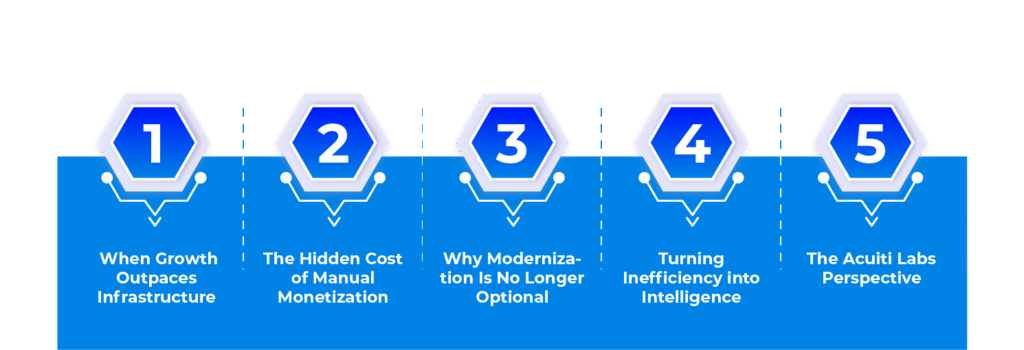
1. When Growth Outpaces Infrastructure

Many established businesses — in sectors like travel, mobility, utilities, and services — built their revenue processes decades ago. Those systems were designed for a smaller, simpler world.

Manual billing, paper contracts, and spreadsheet-based reconciliations worked fine when transaction volumes were manageable. But as these companies scaled, those same systems became the bottleneck.

In today’s environment:

  • Customer expectations evolve faster than billing cycles.
  • Data is scattered across disconnected systems.
  • Operational costs rise even as revenue visibility declines.

Growth exposes the cracks in the foundation. When systems can’t scale, organizations end up compensating with manpower — adding people instead of intelligence.

2. The Hidden Cost of Manual Monetization

Legacy processes create more than inefficiency — they create invisibility.

Revenue leakage becomes almost impossible to detect when every stage of the quote-to-cash process operates in silos.
 Pricing errors, contract mismatches, and billing delays add up to millions in lost or delayed revenue each year.

Common red flags include:

  • Long billing cycles and delayed invoicing
  • Discrepancies between sales quotes and invoices
  • High levels of customer disputes and write-offs
  • Lack of real-time insights into revenue performance

What begins as operational complexity soon becomes a strategic risk.

3. Why Modernization Is No Longer Optional

Digital transformation is often seen as an IT initiative — but in reality, it’s a business imperative.

The need for agile, usage-based, and subscription-driven models means enterprises must adopt systems that allow for flexibility and control at scale.
 Modern monetization platforms like SAP BRIM (Billing and Revenue Innovation Management) are designed for exactly this purpose.

By automating the quote-to-cash lifecycle, organizations can:

  • Integrate contracting, pricing, and billing into a unified flow
  • Automate revenue recognition and reconciliation
  • Reduce manual intervention and eliminate duplication
  • Deliver transparency to both customers and internal teams

The result is not just faster billing — it’s smarter, data-driven revenue management.

4. Turning Inefficiency into Intelligence

The journey from manual to intelligent monetization is not simply about implementing software.
 It’s about aligning people, processes, and performance.

Leaders who recognize inefficiency as a barrier to growth are already ahead. The next step is to convert that awareness into action — by redesigning revenue architecture for scalability and resilience.

With solutions like SAP BRIM, organizations can move from reactive reporting to predictive insight — gaining visibility into how every product, service, and pricing model contributes to top-line growth.

This is where automation meets strategy — where enterprises can finally make decisions based on real-time revenue intelligence instead of retrospective reports.

5. The Acuiti Labs Perspective

At Acuiti Labs, we help enterprises modernize the way they earn.

Our focus goes beyond system implementation — we work with leadership teams to reimagine their entire monetization process, from product design to revenue realization.
 By aligning SAP BRIM capabilities with industry-specific needs, we enable clients to achieve measurable outcomes:

  • Reduction in revenue leakage
  • Improved billing accuracy and customer trust
  • Streamlined operations across finance, sales, and service
  • Scalability for new digital and subscription models

Modern monetization isn’t just about efficiency — it’s about unlocking new growth potential in every transaction.

Building the Foundation for Scalable Growth

The future of business belongs to those who treat revenue operations as a strategic asset, not an administrative function.

Legacy systems built for a slower world cannot support the speed, complexity, and creativity that modern markets demand.
 Enterprises that embrace intelligent monetization today will not just keep pace with growth — they’ll lead it.

At Acuiti Labs, we’re helping businesses do exactly that — transforming how they bill, recognize, and realize revenue in a digital-first economy.

Legacy ERP Billing vs. Quote-to-Cash: A Feature-by-Feature Comparison

In a fast-changing digital economy, companies are under constant pressure to deliver seamless, agile, and customer-centric billing experiences. However, a considerable number of organizations still depend on outdated ERP systems that were created many years ago—mainly for back-office functions rather than dynamic revenue models. As businesses shift toward recurring revenue, subscription models, and usage-based pricing, the limitations of conventional ERP billing become increasingly evident.

Introducing Quote-to-Cash (Q2C)—a modern, integrated solution that unifies the customer journey from quoting to revenue recognition. This blog delves into how Q2C platforms outperform legacy ERP billing by comparing each feature side by side to identify the gaps and demonstrate how Q2C addresses them through automation, analytics, and smart integration.

What Is Legacy ERP Billing?

Legacy ERP billing modules were designed to manage simple, linear billing processes. They emphasize one-off transactions, the creation of invoices, and fundamental financial reconciliation. Although they are effective in overseeing inventory, ledgers, and general financial operations, they do not possess the adaptability to accommodate dynamic pricing strategies, instant modifications, or omnichannel experiences.

What Is Quote-to-Cash (Q2C)?

Quote-to-Cash refers to the end-to-end process that covers the entire revenue lifecycle for customers, ranging from configuring products, determining pricing, and generating quotes (CPQ) to managing orders, billing, invoicing, collecting payments, and recognizing revenue. Q2C solutions are intended to be flexible, modular, and focused on the customer. They bring together sales, finance, legal, and operational teams, fostering improved visibility, collaboration, and decision-making based on data.

Feature-by-Feature Comparison Chart

Feature

Legacy ERP Billing

Quote-to-Cash (Q2C)

Billing Flexibility

Rigid structure; suited for fixed, one-time billing.

Supports one-time, recurring, usage-based, and hybrid models.

Customer Experience

Invoice-centric; limited visibility and manual dispute handling.

Customer portals, self-service, real-time updates, automated issue resolution.

Automation Capabilities

Manual processing; batch-driven; high reliance on human input.

Automated workflows across quoting, approval, invoicing, and renewals.

Revenue Recognition

Basic, often decoupled from billing or done offline.

Integrated ASC 606/IFRS 15 compliance; real-time and automated revenue schedules.

Quote Management

Not included; quoting typically handled by sales tools outside ERP.

Native CPQ capabilities, automated quote generation, and approvals.

Contract Lifecycle Management

Limited or non-existent; managed offline or through add-ons.

Integrated CLM; tracks changes, renewals, and obligations.

Pricing and Discounts

Static pricing tables; limited dynamic pricing or promotions.

Real-time pricing rules, volume discounts, tiering, and bundles.

Data & Analytics

Post-fact reporting; lacks actionable real-time data.

Dashboards, predictive analytics, and real-time insights across sales and finance.

Integration Across Systems

Difficult to integrate with modern SaaS or cloud apps; point-to-point integrations.

API-driven, plug-and-play integrations with CRM, ERP, CPQ, Tax, and Payment Gateways.

Change Management (Mid-Term Edits)

Complex, often requiring cancellations and re-issuance of contracts.

Real-time contract amendments with prorated billing and minimal disruption.

Speed of Deployment

Time-consuming to customize or upgrade; often requires consulting intervention.

Cloud-based, modular deployments with faster time-to-value.

Compliance & Audit Trail

Manual record keeping; limited transparency.

Automated compliance tracking, digital audit trails, version control.

Renewals & Upselling

Manual tracking of contract end-dates; limited support for upsell workflows.

Automated renewals, alerts, and upsell/cross-sell triggers based on customer data.

Why Businesses Are Moving Beyond ERP Billing

As products evolve from static offerings to services or bundles, the billing system must adapt as well. Legacy ERP systems were simply not designed to manage:

  • Subscription models that require billing based on usage, milestones, or consumption.
  • Dynamic pricing that fluctuates according to customer behavior or volume.
  • Changes to contracts during the term, including add-ons or cancellations, which necessitate precise proration and real-time adjustments.

The outcome? Businesses often find themselves stitching together various tools, resulting in silos, inefficiencies, and lost revenue opportunities.

How Quote-to-Cash Addresses These Gaps

Quote-to-Cash process

Quote-to-Cash platforms introduce automation and intelligence to what was previously a disjointed process. Here’s how:

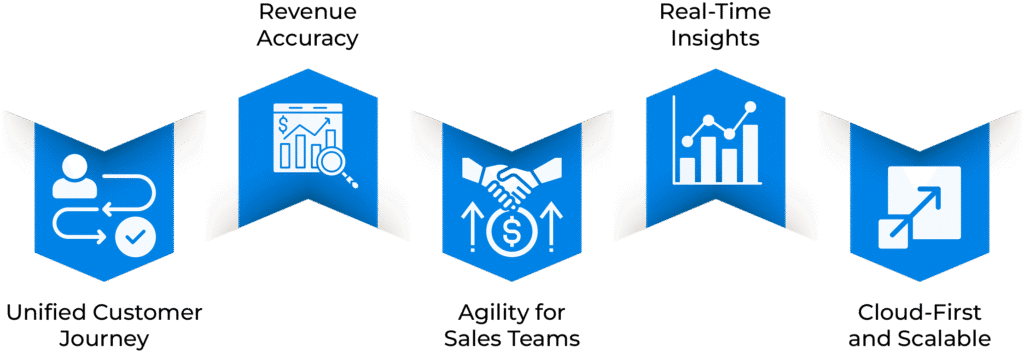
1. Unified Customer Journey

Q2C merges quoting, contracts, billing, and collections into one seamless process. This eliminates hand-offs between teams and delivers a consistent experience for the customer.

2. Revenue Accuracy

Embedded revenue recognition systems ensure compliance to ASC 606 or IFRS 15, minimizing errors and reducing audit risks. It automatically organizes revenue scheduling based on delivery milestones, subscription timelines, or tailored rules.

3. Agility for Sales Teams

Sales teams can quickly create quotes using up-to-date product catalogs and pricing rules. Discounts, approvals, and product combinations are regulated by specific guidelines, ensuring that deals progress rapidly and remain profitable.

4. Real-Time Insights

Through Q2C analytics, teams can monitor key performance indicators such as time-to-cash, customer churn, renewal rates, and projected revenue—all in real-time, facilitating more informed decisions and faster adjustments.

5. Cloud-First and Scalable

In contrast to legacy ERPs that often necessitate extensive infrastructure and updates, many Q2C platforms are built for the cloud and offer scalability, enabling businesses to swiftly respond to changes in the market.

The Verdict

Modern businesses require more than a simple billing solution—they seek an integrated, intelligent revenue operations framework. Although legacy ERP billing systems may meet fundamental financial requirements, they fall short in terms of flexibility, automation, and adaptability necessary for success in today’s subscription-driven market.

Quote-to-Cash provides a revolutionary alternative. By adopting Q2C, organizations can not only eradicate manual inefficiencies but also tap into new revenue opportunities, improve customer satisfaction, and gain insights into all aspects of the revenue process.

Ready to transform your billing operations?
Assess your current ERP limitations and explore how a Q2C platform can fit into your digital transformation strategy.

At Acuiti Labs, we focus on deploying state-of-the-art Quote-to-Cash solutions customized to fit your specific business requirements. With extensive knowledge in SAP BRIM and digital monetization platforms, we assist businesses in optimizing their revenue operations, automating intricate billing processes, and providing outstanding customer experiences. Whether you are upgrading from outdated systems or expanding your subscription business, Acuiti Labs ensures a smooth transition with measurable results. Allow us to transform your billing—more intelligent, quicker, and prepared for the future.

Why Quote-to-Cash Is the New Frontline of Customer Experience

In today’s experience-first economy, the battleground for customer loyalty isn’t just your product or app — it’s your revenue process. From the moment a customer requests a quote to the instant they pay an invoice; every step is a chance to impress or disappoint.

Modern buyers demand speed, personalization, and transparency — and they expect it from every touchpoint. That’s why Quote-to-Cash (Q2C) has emerged as one of the most critical drivers of customer satisfaction and brand perception. It’s no longer a back-office function. It’s the new front line of customer experience.

Quote-to-Cash: More than just a process

Quote-to-Cash isn’t just a series of steps—it’s the pulse of your customer relationship and the foundation of every revenue moment. It starts when a customer first expresses interest and flows through configuring the right solution, pricing it fairly, generating a quote, gaining approval, fulfilling the promise, billing accurately, and finally collecting payment.

In essence, Q2C is the commercial heartbeat of your business—connecting sales, finance, and service into one cohesive customer experience. And in today’s experience-driven world, how smoothly this process runs can make or break customer loyalty.

Why Q2C now defines the customer experience

Q2C defines customer experience

1. Speed and accuracy matter more than ever

Modern customers expect fast, error-free interactions. Delays in quoting or billing errors are not just operational hiccups; they are CX failures. A seamless Q2C process ensures:

  • Faster quote turnaround
  • Accurate, transparent pricing
  • Real-time updates and visibility

2. Personalization starts with the quote

Personalized experiences are key to retention. Q2C platforms like SAP BRIM and Acuiti Labs’ Q2C Customer Portal allow dynamic configurations based on user preferences, contract history, and usage behavior – delivering not just quotes, but personalized offers.

3. Billing simplicity builds trust

Clear, consistent billing builds long-term trust. Confusing invoices or subscription errors lead to frustration and churn. With an optimized Q2C process, businesses can:

  • Offer flexible subscription models
  • Bundle services clearly
  • Enable self-service billing management

4. Revenue leakage is a CX killer

Every error in the Q2C chain – from pricing mismatches to incorrect discounts – can result in lost revenue and lost trust. CFOs and CXOs must now view revenue leakage as a customer experience issue, not just a finance concern.

The Strategic role of technology

At Acuiti Labs, we don’t just implement Q2C solutions—we reimagine how your revenue journey should feel to your customers. As a global specialist in SAP BRIM and end-to-end Q2C transformation, we’ve helped enterprises across industries deliver consistent, intelligent, and intuitive experiences across the entire revenue lifecycle.

Our tailored solutions are designed to:

  • Simplify even the most complex subscription billing ecosystems
  • Accelerate time-to-value with prebuilt sector accelerators in industries like Media, Postal, Transport, and Financial Services
  • Deliver connected, customer-centric touchpoints from quote generation to final payment
  • Prevent revenue leakage with built-in compliance and accuracy frameworks

What truly sets Acuiti Labs apart is our ability to align customer experience goals with financial and operational outcomes. We help CFOs gain visibility and predictability, while enabling Sales and CX leaders to create frictionless buying journeys.

Whether you’re a media company launching dynamic bundles, a logistics firm managing usage billing, or a financial services provider scaling recurring revenue – Acuiti Labs ensures your Q2C engine becomes a source of differentiation, not disruption.

Ready to transform your Q2C experience?

In a world where customer expectations evolve by the minute, your revenue journey can no longer be an afterthought. It must be seamless, intelligent, and deeply customer-centric. That’s the promise of Quote-to-Cash done right — and that’s exactly what Acuiti Labs delivers.

Let’s turn your revenue operations into a strategic advantage — one that not only powers growth, but also inspires loyalty, trust, and long-term value.

Contact Acuiti Labs today and take the first step toward creating unforgettable customer experiences — from the very first quote to the final payment.

Telco Monetization Reinvented: How Q2C and SAP BRIM Unlock Scalable Growth

Telecom operators today face a pivotal moment: traditional revenue streams are under pressure, while digital service demand is surging. What separates industry leaders from the rest is no longer just what they offer — but how effectively they monetize it.

Modern telecom growth requires more than just products. It demands real-time billing agility, seamless integration across the Quote-to-Cash (Q2C) lifecycle, and a revenue infrastructure built for digital scale.

Legacy systems can’t keep up with this new reality. That’s why forward-thinking telcos are embracing intelligent Q2C transformation powered by SAP BRIM — and that’s where Acuiti Labs leads the way.

As a trusted SAP BRIM specialist, Acuiti Labs helps telecom innovators replace legacy complexity with future-ready monetization models. Our Q2C frameworks and industry accelerators enable telecom enterprises to transform revenue operations into a true growth engine — one that’s faster, smarter, and built around the customer.

The Monetization Challenge in Telecom

Telcos are under pressure to:

  • Launch and scale new services rapidly
  • Support usage-based and subscription billing models
  • Deliver real-time visibility to customers and internal teams
  • Ensure compliance with local and global regulations

Yet, most continue to operate on fragmented systems, causing delays, revenue leakage, billing disputes, and poor customer experiences.

A robust, end-to-end Q2C process bridges these gaps—connecting product configuration, pricing, quoting, order management, billing, and revenue recognition into a unified, agile infrastructure.

Brightspeed’s Q2C Transformation: A Telco Success Story

One of the most powerful examples of Q2C transformation in telecom comes from our ongoing engagement with Brightspeed. Over the last two years, Acuiti Labs has played a key role in helping Brightspeed exit legacy systems and modernize its Order-to-Cash and Customer Financial Services with SAP BRIM, RAR, and Acuiti’s Q2C Portal.

Key Highlights:

  • Migrated 10 new states, bringing the total to 12 transitioned from legacy systems
  • Migrated 600,000+ billing accounts, including open AR, disputes, collections, credit profiles
  • Achieved 99%+ accuracy in data processing through SAP RAR
  • Delivered 45+ business capabilities, including PayPal integration, Suspend/Restore, Late Fees, and historical refunds
  • Processed 140,000+ payments totaling over $15.5M post cut-over
  • Completed Brightspeed’s first-ever disputes migration
  • Validated scalable integrations with CPQ, Certify Tax, CSG, Vertex, and credit agencies

This success reflects not only the strength of our SAP BRIM expertise but also the power of strategic Q2C architecture in enabling telcos to scale with confidence.

What Sets Acuiti Labs Apart in Telco Q2C

Q2C transformation telecom

At Acuiti Labs, we don’t just implement technology — we deliver outcomes that matter to telecom businesses. Our deep engagement with telco clients has shaped a uniquely practical and high-performance approach to Q2C transformation:

  • Industry-Embedded Expertise: We understand the intricacies of telecom product hierarchies, bundling, regulatory demands, and regional variations in billing.
  • Pre-Built Accelerators & Migration Frameworks: We bring ready-to-deploy toolkits that reduce time-to-market and de-risk legacy transitions.
  • Acuiti labs’ Q2C Customer Portal: Built to enhance SAP BRIM, this self-service portal adds real-time visibility, enhances customer experience, automates workflows, and adds a superior UI layer to support both business and IT teams.

Integrated Ecosystem Enablement: From CPQ and tax engines to credit checks and collections, we ensure your Q2C landscape works as a seamless whole.

Through our tailored solutions, we empower telecom providers to:

  • Eliminate fragmentation and unify revenue processes across silos
  • Accelerate time-to-cash by automating billing and collections
  • Enhance customer experience with clear, transparent billing journeys
  • Launch new offerings faster without rebuilding backend architecture

Every engagement is built on partnership, precision, and performance — with measurable results in speed, accuracy, and operational efficiency.

Looking Ahead: Scalable, Sustainable Growth

Brightspeed’s journey continues with key upcoming milestones, including:

  • Tranche 1 Conversion 3
  • CABS T2 rollout
  • MBS Exit in Q3

Each step brings them closer to a truly agile and intelligent monetization framework—paving the way for innovation, customer retention, and long-term value.

Ready to Reimagine Monetization?

The future of telco success will be written by those who modernize boldly. Whether you’re launching new offerings or re-architecting legacy platforms, monetization agility is the new competitive edge.

At Acuiti Labs, we partner with telecom leaders to unlock operational efficiency, improve billing accuracy, and accelerate time-to-revenue — all through the power of SAP BRIM and an integrated Q2C strategy.

Let’s build your next chapter of growth — faster, smarter, and future-ready.

📞 Talk to our telecom Q2C specialists to explore a future-ready approach to billing transformation.

Reimagining Revenue in 2025: Subscription Monetization Trends That Matter

With the first quarter of 2025 already behind us, it’s clear the subscription economy is accelerating into a more complex, competitive, and high-stakes environment. Enterprises are no longer just offering recurring services — they’re engineering agile, data-informed monetization strategies that deliver measurable customer and business value.

Welcome to the new era of revenue innovation, where personalization, real-time billing, global scalability, and customer experience (CX) converge — all underpinned by a future-ready Quote-to-Cash (Q2C) infrastructure.

At Acuiti Labs, an SAP-certified implementation specialist, we help enterprises transform and modernize their billing and revenue management processes. Through tailored SAP BRIM and end-to-end Q2C solutions, we empower organizations to unlock scalable monetization models and deliver seamless customer experiences. Here’s what will define success in 2025:

Subscription monetization models

1. Unlocking Growth with Customer-Centric Pricing Models

Generic pricing models are becoming obsolete. Businesses that lead in 2025 will:

  • Tailor pricing dynamically based on usage, behavior, or geography
  • Offer modular, build-your-own bundles
  • Implement loyalty-driven tiering and offers

Acuiti Labs’ SAP BRIM consulting enables flexible configuration and scalable personalization using SAP BRIM, helping businesses meet customer expectations with precision.

2. Real-Time Revenue: Accuracy as a Competitive Advantage

The lag between usage and billing is shrinking. Successful organizations are shifting to:

  • Real-time data ingestion and usage tracking
  • On-demand invoicing and billing reconciliation
  • Automated compliance and reporting for revenue recognition

We deliver systems that handle real-time billing at enterprise scale — reducing errors, revenue leakage, and customer dissatisfaction.

3. Q2C as a CX Strategy

Every billing interaction is a brand moment. A streamlined Q2C process can:

  • Reduce sales cycle friction
  • Increase transparency across pricing and renewals
  • Improve customer retention through predictable engagement

Our end-to-end approach connects customer experience teams with finance and operations — closing the gap between selling and servicing.

4. Monetizing Globally, Managing Locally

Cross-border subscriptions are on the rise — but so are regional compliance challenges. Enterprises need:

  • Multi-currency, multi-entity billing capabilities
  • Country-specific tax compliance frameworks
  • Agile deployment models that scale without sacrificing governance

Our SAP BRIM solutions are built to adapt — empowering businesses to expand globally without complexity.

5. The Rise of Everything-as-a-Service (XaaS)

Industries are transforming traditional products into recurring services. This includes:

  • Mobility and transport shifting to pay-per-use models
  • Media and content brands bundling digital services
  • Financial services introducing micro-subscription and fee-based engagement

We help organizations re-platform around subscription-first thinking — launching new revenue models faster and with lower risk.

Building the Backbone of Recurring Revenue

In the Subscription Economy 2.0, success will no longer be determined by who launches the most subscription plans — it will be defined by who monetizes them most effectively. Subscription-based growth demands more than innovation on the surface. It requires operational precision, financial clarity, and customer-centric agility deep within the enterprise.

Today’s competitive edge lies in how businesses orchestrate their entire revenue journey. That means synchronizing every function — from product configuration to pricing, contracting, fulfillment, billing, and revenue recognition — into one intelligent, future-ready infrastructure.

The real transformation begins when your Quote-to-Cash processes become more than just transactional. They become experiential, strategic, and scalable — unlocking new revenue streams, elevating customer trust, and enabling faster go-to-market capabilities.

Modern enterprises must replace fragmented legacy systems with connected, adaptive, and compliance-ready Q2C architectures that support real-time decision-making and global monetization at scale.

Your Catalyst for Scalable Monetization

Acuiti Labs is not just a service provider — we are a transformation enabler. With deep expertise in SAP BRIM and a laser focus on monetization and Q2C excellence, we empower global enterprises to convert complexity into clarity and innovation into recurring revenue.

Our approach blends:

  • Industry-aligned accelerators for faster time-to-value
  • Proven implementation frameworks built around scalability, security, and compliance
  • Global reach with localized execution, ensuring every deployment is business-ready from day one

We work alongside finance, IT, operations, and customer experience teams to deliver measurable results — from cost optimization and improved billing accuracy to faster cash flow and increased customer retention.

If you’re ready to reimagine your monetization strategy, elevate your Q2C infrastructure, and build a competitive edge that lasts — we’re ready to lead that journey with you.

Talk to Acuiti Labs — and let’s shape the future of subscription monetization, together.

Contact us today!

How Subscription Models are Shaping the Future of Quote-to-Cash

Subscription-based business models have gained immense traction across industries, transforming the way companies generate revenue. From Software-as-a-Service (SaaS) platforms and media streaming services to traditional product-based companies shifting towards subscription-based offerings, this evolution is driving a need for more dynamic and efficient billing and revenue management systems.

At the core of this shift is the Quote-to-Cash (Q2C) process, which manages everything from customer quotations to revenue collection. Businesses adopting subscription models require streamlined Q2C processes to handle complex pricing, recurring billing, renewals, and revenue recognition. In this blog, we will explore how subscription models impact Q2C, how businesses can adapt, and how SAP BRIM (Billing and Revenue Innovation Management) plays a pivotal role in managing recurring revenue models.

Why Are Subscription Models Becoming Popular?

subscription models

Subscription models are gaining popularity due to their ability to create predictable revenue streams and strengthen customer relationships. Here’s why businesses are making the shift:

Predictable Revenue Streams – Recurring billing provides businesses with steady cash flow and improves revenue forecasting.

Customer Retention & Loyalty – Subscriptions enhance customer lifetime value through renewals, upselling, and cross-selling opportunities.

Flexible Payment Options – Customers prefer flexible pricing plans that allow access to services without large upfront costs.

Data-Driven Business Insights – Subscription models generate valuable customer data, enabling businesses to personalize offerings and optimize pricing strategies.

This model benefits both businesses and consumers, making it a preferred choice across industries such as telecom, SaaS, media, utilities, and transportation.

How Subscription Models Impact the Q2C Process

Transitioning to a subscription model affects multiple elements of Q2C, requiring businesses to rethink traditional revenue management strategies. Here’s how:

  1. Dynamic Quoting & Contracting – Subscription models introduce complexities like tiered pricing, custom bundles, and consumption-based billing. A robust Configure, Price, Quote (CPQ) system is essential for accurate pricing.
  2. Automated Recurring Billing & Payments – Businesses need a flexible billing system to handle monthly, quarterly, or annual payments. Automation reduces manual efforts and improves collection efficiency.
  3. Renewals & Retention Strategies – Subscription businesses rely on seamless renewals. Automating renewal workflows with personalized offers helps reduce churn.
  4. Real-Time Revenue Recognition – Managing recurring revenue requires real-time tracking and compliance with financial reporting standards.

By adapting the Q2C process to support subscriptions, companies can ensure seamless transactions while delivering superior customer experience.

Why Businesses Need SAP BRIM for Subscription-Based Q2C

To navigate the complexities of subscription-based revenue, businesses require a robust, scalable, and automated billing solution. SAP BRIM is designed to handle end-to-end subscription management, from customer onboarding to revenue collection.

Key Benefits of SAP BRIM in Subscription-Based Q2C:

Benefits of SAP BRIM in Subscription-Based Q2C

Automated Billing & Revenue Recognition – Eliminates manual errors and ensures compliance with financial standards.

Flexible Pricing & Bundling – Supports dynamic pricing models, consumption-based billing, and multi-tier subscriptions.

Seamless Integration with CRM & ERP – Integrates with SAP S/4HANA, SAP Subscription Billing, and SAP Entitlement Management, ensuring smooth data flow.

Customer Self-Service & Transparency – Enables customers to manage subscriptions, payments, and disputes through self-service portals.

Improved Cash Flow Management – Enhances revenue predictability and boosts investor confidence.

SAP BRIM is a future-proof solution, allowing businesses to scale subscription models efficiently while improving revenue management.

Overcoming Challenges in Subscription-Based Q2C

While subscription models offer several advantages, businesses may face key challenges in execution:

  1. Managing Customer Churn – Implementing proactive retention strategies and personalized engagement helps reduce churn.
  2. Handling Complex Billing Scenarios – Businesses need a comprehensive billing system that supports tiered pricing, multi-currency transactions, and diverse contract structures.
  3. Real-Time Analytics for Decision-Making – Leveraging AI-driven analytics helps forecast demand, optimize pricing, and improve customer satisfaction.

With SAP BRIM, businesses can address these challenges by leveraging automation, analytics, and seamless integration with enterprise systems.

The rise of subscription models is transforming how businesses quote, bill, and collect payments. To remain competitive, companies must shift towards scalable, automated, and flexible Q2C processes that support recurring revenue streams.

SAP BRIM empowers businesses to manage the entire subscription lifecycle efficiently, from dynamic pricing and automated invoicing to revenue recognition and churn reduction. By adopting SAP BRIM, businesses can enhance operational efficiency, improve financial predictability, and deliver superior customer experiences.

Are you ready to transition to a subscription-based Q2C model? Acuiti Labs specializes in SAP BRIM implementations to help businesses transform revenue management. Contact us today to explore how we can optimize your subscription-based billing processes.

📧 Get in touch at info@acuitilabs.com or visit www.acuitilabs.com

Quote-to-Cash Process Transformation: How to Future-Proof Your Revenue Management

In a rapidly evolving digital landscape, businesses must rethink their revenue management strategies to stay competitive. Traditional revenue models are being disrupted by subscription services, dynamic pricing, and complex billing structures. To navigate these changes effectively, companies must transform their Quote-to-Cash (Q2C) processes to enhance efficiency, accuracy, and scalability.

By leveraging SAP Billing and Revenue Innovation Management (SAP BRIM), organizations can automate billing, optimize revenue recognition, and future-proof their revenue streams. This transformation enables businesses to streamline quoting, contracting, billing, and collections, ensuring long-term success in an increasingly complex market.

Understanding Quote-to-Cash: The Backbone of Revenue Management

ðŸ—Ģïļ Dive deeper into Q2C transformation! Hear how businesses like yours are optimizing revenue operations in our podcast series.

revenue management

Quote-to-Cash (Q2C) is an end-to-end business process that covers everything from customer quotation to final payment collection. It encompasses:

Understanding Quote-to-Cash: The Backbone of Revenue Management

Quoting & Contract Management – Ensuring accurate pricing and streamlined contract approvals.

Order Fulfillment & Billing – Managing sales orders and automating complex billing scenarios.

Revenue Recognition & Compliance – Ensuring accurate financial reporting and regulatory adherence.

Modern Q2C processes must support subscription-based, consumption-based, and hybrid revenue models to meet evolving customer demands.

Key Challenges in Revenue Management

Businesses transitioning to new pricing models face multiple challenges:

  1. Managing Complex Pricing Structures – Subscription, usage-based, and tiered pricing models require flexible billing solutions.
  2. Revenue Leakage – Manual processes, billing errors, and mismanagement can lead to significant financial losses.
  3. Slow Market Adaptation – Legacy systems delay product launches and pricing adjustments.
  4. Data Fragmentation – Disconnected sales, finance, and billing data impede financial transparency.
  5. Regulatory Compliance – Navigating global financial regulations requires automated tax calculations and revenue tracking.

How SAP BRIM Powers Quote-to-Cash Transformation

SAP BRIM (Billing and Revenue Innovation Management) is designed to handle high-volume, subscription-based, and dynamic pricing models. It empowers businesses to:

Automate Billing & Invoicing – Reduces manual errors and accelerates cash flow.

Enable Scalable Pricing Models – Supports flexible pricing, subscriptions, and promotions.

Improve Customer Experience – Provides self-service portals, real-time notifications, and personalized billing options.

Seamlessly Integrate with Enterprise Systems – Connects with CRM, ERP, and financial reporting systems for real-time insights.

Ensure Global Compliance – Automates tax calculations and regulatory adherence.

Future-Proofing Revenue Management with SAP BRIM

As businesses move towards digital-first monetization strategies, adopting SAP BRIM within Q2C processes offers a competitive advantage:

Future-Proofing Revenue Management with SAP BRIM
  1. Launch New Revenue Models Quickly – Supports consumption-based, pay-as-you-go, and hybrid billing models.
  2. Drive Sustainable Growth – Enhances cash flow predictability and investor confidence.
  3. Achieve Agility & Scalability – Ensures businesses can rapidly adjust to market trends and customer demands.

Transforming the Quote-to-Cash process is essential for businesses looking to future-proof their revenue management. SAP BRIM provides the automation, scalability, and compliance necessary to navigate modern billing complexities, ensuring seamless revenue operations.

Is your business ready for Q2C transformation? Partner with Acuiti Labs to implement SAP BRIM and optimize your billing and revenue processes.

📧 Contact us at info@acuitilabs.com or visit Acuiti Labs to explore how we can help you stay ahead in the digital economy.

Insights from the Q2C Summit 2024: Transforming Quote-to-Cash Processes

On October 24, 2024, industry leaders gathered at The Shard in London for the highly anticipated Quote-to-Cash (Q2C) Summit 2024. This event brought together experts from various sectors to discuss the latest trends, challenges, and innovations in the Q2C process. Here are some key takeaways from the summit.

Welcome and Opening Remarks

Quote to Cash Summit

The summit kicked off with a warm welcome from Manoj Harbhajanka, CEO of Acuiti Labs. He set the stage for a day filled with insightful presentations and discussions aimed at transforming Q2C processes to drive business value.

Strategic Value Creation Through Pricing

Alex Dumbell, Managing Director & Partner at Boston Consulting Group, delivered an inspiring presentation on the transformative potential of value-based pricing. He emphasized that while B2B players face challenges with internal processes and analytical capabilities, adopting value-based pricing can significantly enhance their commercial agility. By aligning pricing models with innovation and customer investments, companies can achieve a noticeable  bottom-line improvement.

Q2C Process Transformation: Perspectives and Success Stories

The summit featured several sessions on Q2C process transformation, including:

  • oCFO Perspective by SAP: Kristianne Perry from SAP discussed the strategic importance of Q2C transformation from a CFO’s perspective. Putting emphases on the need for greater capabilities in automating quote-to-cash processes to enhance financial resilience and agility.
  • Automating Quote-to-Cash by DigitalRoute: Andreas Zartmann, CEO of DigitalRoute, shared insights on the growing importance of flexible, digital Q2C solutions in the subscription economy. He highlighted how automation can lead to significant reductions in operational costs and improvements in customer satisfaction.
  • Q2C Transformation – Maximising Enterprise Value by Acuiti Labs: Manoj Harbhajanka, CEO of Acuiti Labs, emphasized the strategic priorities of customer focus, agile pricing, and digital innovation as essential drivers of an optimized Q2C process. He showcased how these elements boost efficiency, enhance customer experience, and maximize enterprise value.
  • Q2C Transformation Success Stories: Representatives from Criteo and Posti shared their success stories in transforming their Q2C processes. They discussed the challenges they faced, such as revenue leakage and high DSO, and how they overcame these issues through innovative solutions and strategic partnerships.

Fireside Chat: Maximizing Enterprise Value

Q2C Summit Fireside chat

The day concluded with a fireside chat featuring industry leaders, including Manoj Harbhajanka, Kristianne Perry, Andreas Zartmann, and Abdelkader Bahedi from Criteo. They discussed the future of Q2C transformation and the role of advanced technologies in maximizing enterprise value.

Key Takeaways

  1. Value-Based Pricing: Emphasizing value-based pricing can significantly enhance profitability by better aligning pricing models with customer value and innovation.
  2. Automation and Digital Solutions: Implementing automated Q2C processes can reduce operational costs, improve accuracy, and enhance customer satisfaction.
  3. Strategic Partnerships: Collaborating with technology partners and leveraging advanced solutions can help businesses overcome Q2C challenges and drive growth.
  4. Customer-Centric Approach: Understanding and addressing customer needs throughout the Q2C process is crucial for maintaining competitive advantage and fostering long-term relationships.

Conclusion

Quote to Cash Summit organisers

The Q2C Summit 2024 provided valuable insights into the evolving landscape of quote-to-cash processes. By embracing value-based pricing, automation, and strategic partnerships, businesses can transform their Q2C processes to unlock new revenue streams, improve efficiency, and enhance customer satisfaction. As the market continues to evolve, staying ahead of these trends will be key to achieving sustained growth and success.

Webinar Registration

US Session Registration

Most Awaited BRIM Event 2022

Acuiti Labs is the PLATINUM SPONSOR for the BRIM International Conference, happening in Chicago

26 - 27 October 2022

REQUEST A DEMO

We’re looking forward to meeting you.