
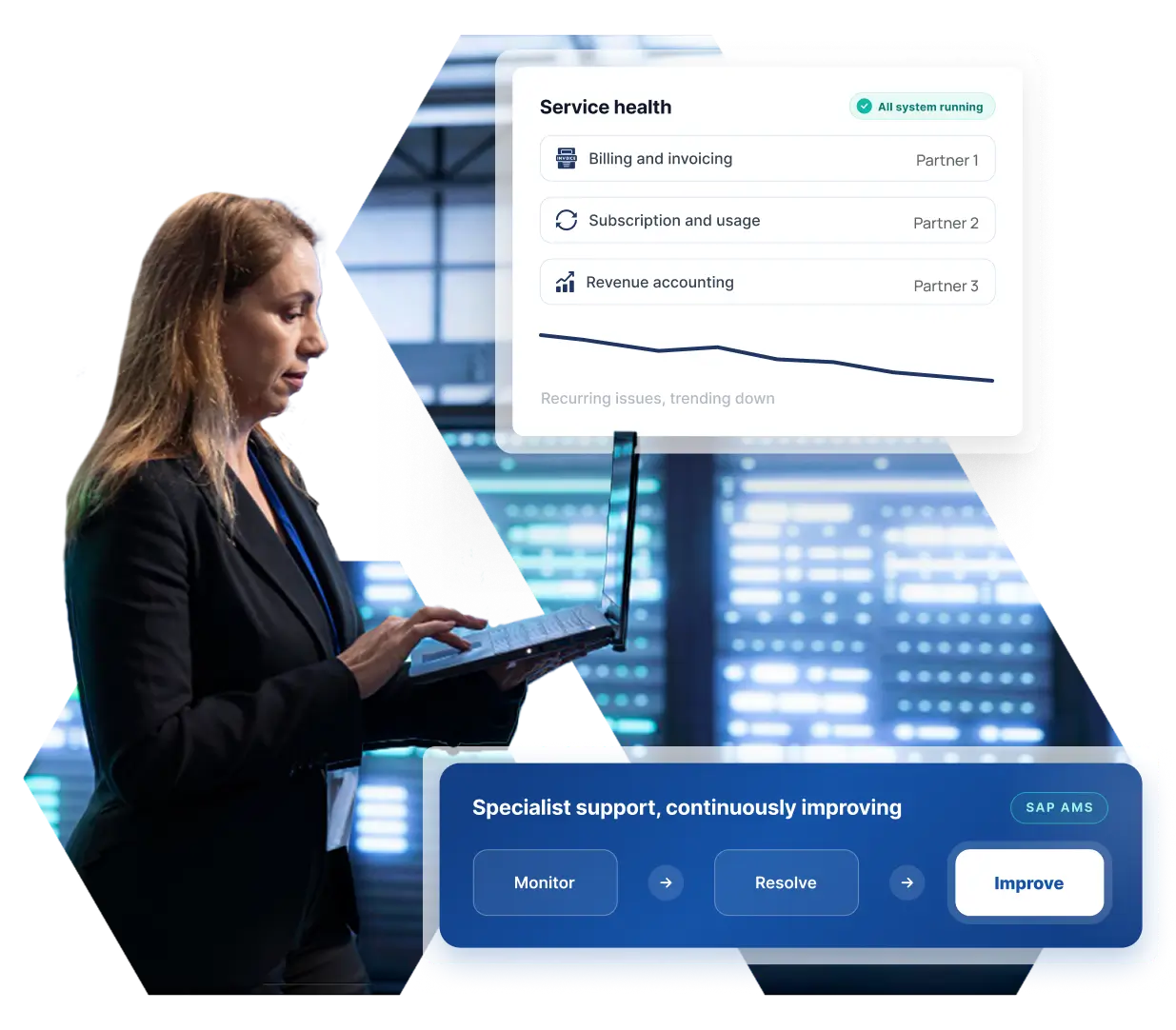
SAP BRIM supports processes that directly affect billing, invoicing, receivables and revenue. Our Application Management Services help keep those operations dependable while giving internal teams more capacity to focus on business change.
Keep critical billing and revenue processes supported through structured monitoring and service management.
Address root causes to reduce repeated incidents and operational disruption.
Free internal teams from recurring support while keeping pace with releases, enhancements and changing requirements.
Bring clear ownership, service levels, reporting and governance around the managed environment.
A cross skilled team with documented knowledge and backups, so support never relies on one individual.
Our SAP BRIM Application Management Services combine functional, technical and integration capability across core BRIM and the systems around it.
Subscription orders and lifecycle processes
Charging, rating and pricing logic
Billing and invoicing processes
Receivables, payments, dunning and collections
Effective SAP AMS should do more than restore service. An end-to-end Quote-to-Cash view brings traceability from order capture through charging, invoicing, receivables and revenue, helping diagnose integration issues across workstreams while improving service performance over time.
Strengthen operational controls and working practices to reduce avoidable issues.
Monitor critical billing, invoicing and FI-CA job chains, error queues and stuck documents to identify issues early, before they affect end customers.
Restore service quickly, then use detailed root cause analysis and permanent fixes to address recurring incidents at source.
Use service trends, automation and operational insight within an ITIL aligned framework, with SLA reporting built in, to reduce repetitive work and continuously improve service performance.
Triage, health checks, resolve any impediments and manage P1/P2 escalation.
Status, SLA compliance, open incidents and upcoming changes.
Service review against SLAs and KPIs, ticket driver trends and improvement tracking.
CSAT, roadmap, and scope and capacity review.
The right SAP BRIM managed services model depends on business criticality, support demand, required coverage and how frequently the environment changes.

A named team aligned to your environment, priorities, and agreed service levels. Best when BRIM is business-critical, high-volume, and changes often.

Flexible access to specialist BRIM capability as requirements rise and fall. Best when volumes vary or budget needs to flex across modules and periods.

A defined level of specialist capacity for predictable ongoing requirements. Best when demand is steady, or as a baseline before committing to a larger model.
Coverage can be shaped around operational priorities, including releases, bill runs, period close and major incidents.
SAP Application Management Services provide ongoing support for SAP environments, covering incident management, problem management, service requests, monitoring, changes, releases and continuous improvement.
SAP BRIM Application Management Services can cover Subscription Order Management, Convergent Charging, Convergent Invoicing and Contract Accounting, along with connected revenue solutions, integrations and technical services.
Yes. Support covers on premise, private cloud and public cloud landscapes, including RISE with SAP.
No. BRIM is a core area of specialization, but support can extend into connected revenue solutions and surrounding SAP and non SAP applications where they form part of the operating landscape.
Yes. A structured transition can include knowledge acquisition, shadow support, reverse shadow and staged service ownership before ongoing delivery begins. A typical transition takes 4 to 6 weeks, depending on landscape complexity.
Yes. The service can be scoped around specific components, applications or operational responsibilities, with ownership boundaries agreed at the outset.
Support can be structured through dedicated teams, shared specialist capability or committed capacity, depending on demand, coverage requirements and the level of dedicated support required.
Agreed SLAs, KPIs, service reviews, trend analysis and improvement plans provide ongoing visibility into service performance and priorities.
Jira, ServiceNow or your existing ticketing tool, with dashboards your leadership can access directly.
AI and automation can support targeted operational activities such as recurring analysis, validation, exception handling and repetitive service tasks, helping reduce manual effort and create more capacity for improvement.
Whether you are transitioning from another provider, strengthening an internal support model or improving an established SAP BRIM environment, our specialists can help define the right service approach.
