
The U.S. telecommunications industry is undergoing one of the most significant transformations in its history. As providers expand into fiber broadband, 5G wireless, IoT connectivity, and bundled digital services, the way they manage the Quote-to-Cash (Q2C) lifecycle is being fundamentally redefined.
Telecom operators now serve highly diverse customer segments – Enterprise, Wholesale, and Consumer – each with unique expectations for pricing, billing, and customer experience. At the same time, consumer behavior is evolving rapidly: digital-first engagement, subscription fatigue, and growing demand for flexible, transparent payment options are reshaping how services are marketed, sold, billed, and supported.
This is not just a technology upgrade. It’s a reinvention of how telecoms embed trust, transparency, and empathy into every step of their revenue process.
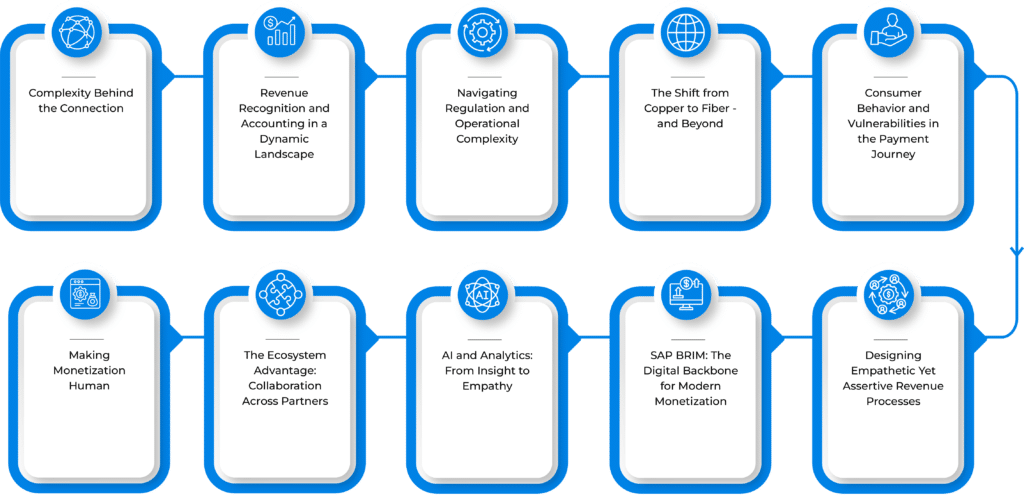
1. Complexity Behind the Connection
Telecom providers operate across a vast ecosystem of products and markets.
- Enterprise customers demand managed network services, SD-WAN, aid-to-construction, damage & claims, cloud connectivity, and complex SLAs.
- Wholesale carriers depend on interconnect agreements, backhaul services, and leased infrastructure.
- Consumer subscribers expect broadband, IPTV, mobile, and smart-home solutions with instant activations and seamless self-service.
Each domain brings its own pricing logic, billing cycles, and contractual structures. Unifying them under a single Q2C framework – while managing legacy systems and manual processes – is a monumental challenge. The complexity compounds when service lines overlap or share dependencies across platforms, making agility and accuracy equally essential.
2. Revenue Recognition and Accounting in a Dynamic Landscape
Bundled offerings are now the norm in U.S. telecom – “fiber + mobile + entertainment” for consumers, or “business broadband + managed Wi-Fi + security” for enterprises. Each bundle contains multiple revenue types: recurring, one-time, and usage-based, each requiring different accounting treatments under ASC 606 / IFRS 15.
Deferred installations, promotional credits, and evolving contract terms add further complexity. Without automation and integration, these challenges manifest as reconciliation delays, compliance risk, and potential revenue leakage. Automated and standardized revenue recognition within an integrated platform is no longer a back-office task – it’s a strategic necessity.
3. Navigating Regulation and Operational Complexity
Operating across the U.S. means managing a web of federal, state, and local regulations:
- Taxes and Fees such as FCC contributions, Universal Service Fund (USF), and state surcharges.
- Customer Communications requirements for notices related to suspensions, disconnections, and billing transparency.
- Service Interruptions and Protections that demand strict adherence to timelines and consumer protection laws.
Non-compliance not only exposes providers to penalties but also erodes customer trust – a critical differentiator in an increasingly competitive market.
4. The Shift from Copper to Fiber – and Beyond
The transition from copper infrastructure to fiber networks represents both an operational and commercial turning point for telecoms. This evolution enables next-generation services like gigabit broadband, IPTV, VoIP, and connected home ecosystems, while 5G fixed wireless and IoT are further redefining service boundaries.
However, legacy billing and CRM systems, built for static rate plans, struggle to support event-driven, dynamic monetization. Modernizing Q2C processes is therefore foundational – not only to support emerging business models but to ensure compliance, speed, and a consistent customer experience.
5. Consumer Behavior and Vulnerabilities in the Payment Journey
Today’s consumers expect their telecom experience to be as seamless as their favorite streaming platform – instant account setup, real-time billing, flexible payment methods, and personalized offers.
Yet, even small process gaps – a delayed payment posting or auto-pay failure – can lead to late fees, service suspension, or disconnection. These incidents don’t just frustrate customers; they damage brand loyalty. In a market where connectivity is essential, such lapses feel personal. This highlights a critical truth: revenue processes are not purely financial – they’re emotional touchpoints.
6. Designing Empathetic Yet Assertive Revenue Processes
Revenue assurance and empathy can – and must – coexist.
Telecoms can achieve this by reimagining Q2C with human-centered design principles:
- AI-driven segmentation to personalize outreach and dunning based on payment behavior and history.
- Adaptive communication strategies that adjust tone, timing, and channel to customer sentiment.
- Flexible payment and installment options to reduce involuntary churn.
- Predictive analytics to identify potential non-payment or dispute cases before they escalate.
Empathy doesn’t mean leniency; it means precision and fairness – enforcing accountability while protecting relationships.
7. SAP BRIM: The Digital Backbone for Modern Monetization
To address this complexity, telecoms are increasingly turning to intelligent digital platforms such as SAP Billing and Revenue Innovation Management (BRIM).
SAP BRIM offers a unified foundation to:
- Manage subscription, usage-based, and one-time billing on a single scalable platform.
- Automate revenue recognition and ensure compliance across diversified product portfolios.
- Integrate real-time order, billing, and finance data for end-to-end transparency.
The greatest impact of BRIM lies not just in automation, but in process harmonization – ensuring consistency across the enterprise, from sales to finance to customer care.
8. AI and Analytics: From Insight to Empathy
Artificial intelligence and analytics are reshaping every layer of the Q2C process:
- Predictive insights into payment default risk and churn behavior.
- Dynamic credit and dunning strategies tailored to customer sentiment and past patterns.
- Automated dispute resolution, classifying and resolving billing variances faster through NLP and ML models.
- Billing variance detection to proactively flag anomalies before they reach the customer.
- Payment reconciliation intelligence to automatically match and correct misapplied or missing payments.
These AI-driven capabilities improve accuracy, reduce operational effort, and build a more transparent and empathetic customer experience.
9. The Ecosystem Advantage: Collaboration Across Partners
Large-scale Q2C transformation requires deep collaboration across the ecosystem. Consulting organizations like Acuiti Labs and technology partners such as SAP bring together domain expertise, implementation accelerators, and best practices for integrating business and IT processes.
This symbiotic relationship enables telecoms to modernize faster while ensuring compliance and customer-centricity. It also represents a major growth opportunity for consulting and technology partners as Q2C modernization becomes central to telecom evolution.
10. Making Monetization Human
Telecom providers do more than deliver connectivity – they connect lives and businesses. Every quote, order, invoice, and payment interaction is a moment that shapes customer trust.
By combining robust digital platforms like SAP BRIM, AI-driven intelligence, and human-centered design, telecoms can transform monetization into a strategic differentiator. In doing so, they achieve what every modern enterprise seeks – operational excellence that feels personal, and empathy that drives revenue.
Because the future of monetization isn’t just digital – it’s human.
Increasing complexity across subscription, usage-based, and bundled services makes a modern Quote-to-Cash approach essential for ensuring compliance, agility, and a seamless customer experience. With deep expertise in telecom monetization and SAP BRIM implementation, Acuiti Labs helps organizations build scalable, future-ready Q2C processes that improve billing accuracy, streamline revenue recognition, and enhance customer engagement.
Looking to modernize your telecom monetization strategy?
Connect with Acuiti Labs to explore how intelligent Quote-to-Cash transformation can support your growth and compliance objectives.